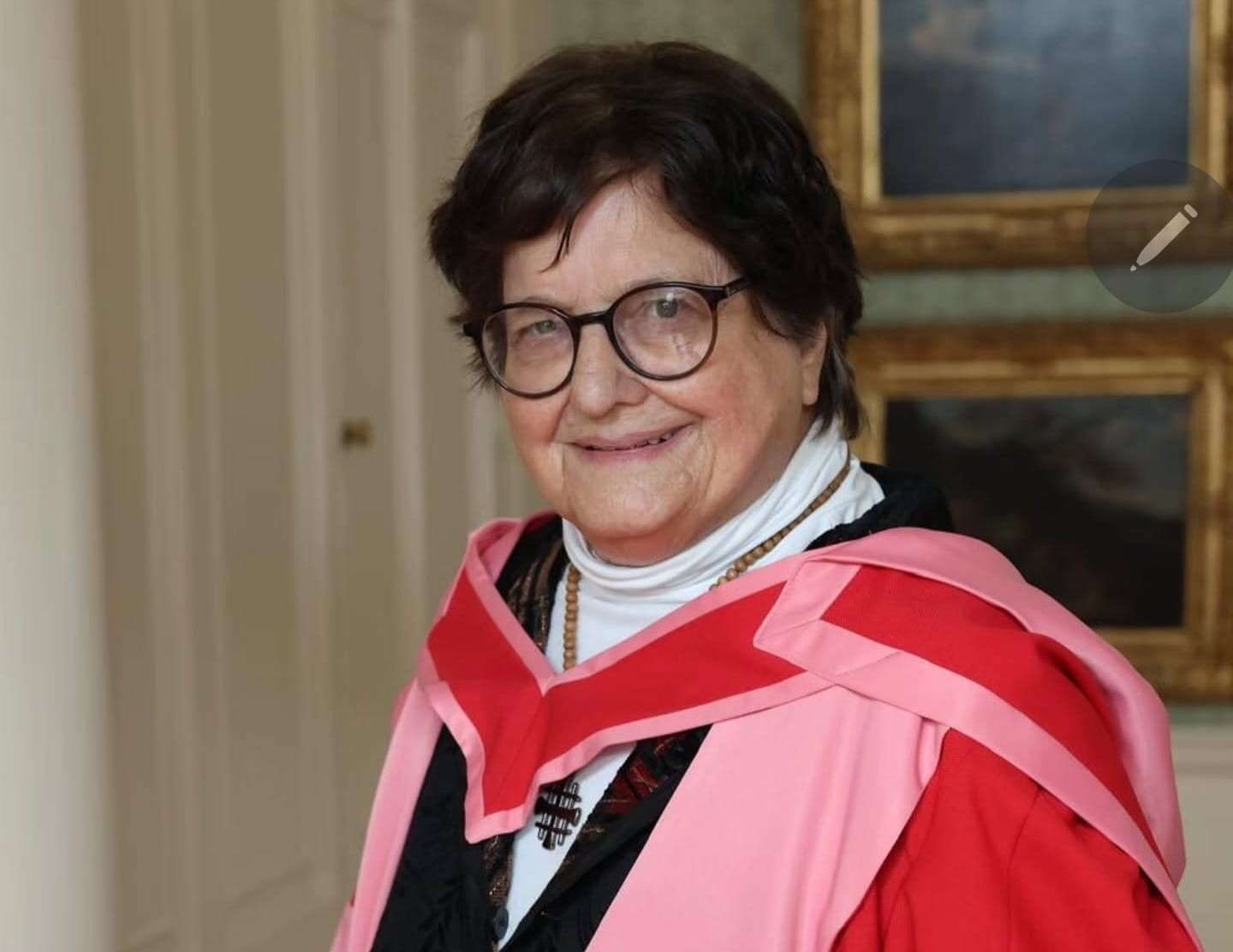
There may be many times when we are powerless to prevent injustice, but there must never be a time when we fail to protest” are words of wisdom from Elie Wiesel, well-known and much-loved Holocaust survivor. A stunning exemplification of this is the protest of Sister Helen Prejean, C.S.J. of New Orleans, who was among the recipients of honorary doctorates awarded by Trinity College Dublin at a Commencement Ceremony on June 19, 2026. Helen was honored for her tireless ministry to end the death penalty as a method of criminal punishment in the United States, and elsewhere in the world. Currently the death penalty is legal in about half of the States in the United States; the Federal Government also carries out executions. Yes, many of those on death row have committed heinous crimes for which they must be held accountable and humanely punished. However, Helen’s message is loud and clear. We do not solve one murder by carrying out another government sanctioned one. Helen’s call is to protect the human dignity of those on death row and provide them with an opportunity to reform. She also tries to minister to the relatives of the victims.
On Helen’s recent visit to Ireland, we Holy Faith Sisters and our friends were privileged to have her visit us in leafy and lush Glasnevin on a warm and sunny midsummer’s day. Helen brought an extra ray of sunshine and hope to us. She helped us retrieve our baptismal call to work as best we can to bring about social transformation in our areas of influence. Sisters of the Holy Faith, based in Ireland are also on mission in both California and Louisiana as well as Trinidad, New Zealand and South Sudan. California and Louisiana continue to be death penalty states. Jeff Landry, the current governor of Louisiana declared at the beginning of his term of office his intention to “clean out death row.” Louisiana has circa fifty-five prisoners on its death row. Landry also worked to get the legislature to pass a law to expand the methods of execution to better facilitate his project. Although the death penalty remains legal in California its practice is currently frozen.
Helen traced the history of her ministry, beginning with how her personal spiritual awakening happened. Like many in the segregated South Helen grew up in relative privilege. However, she began to learn that the United States continues to reckon with its history of chattel slavery. The Southern States, mostly former Confederate States, are the places where the death penalty is most frequently practiced. Many being executed are Black. Some are guilty of the crimes for which they are executed. However, the pro-bono work of “Innocence & Justice Louisiana” lawyers, who have successfully managed to have so many convictions overturned, testifies that not all prisoners are guilty of the crimes for which they have been convicted. Economic, educational and social deprivation most likely prevent some getting adequate legal defense and so they end up in prison, some on death row. The Catholic Church’s recently developed position regarding the death penalty has greatly helped the campaign to which Helen is devoted. Helen therefore feels optimistic and uses every opportunity available to keep the issue on the public agenda. Accompanying death row prisoners on their final journey, giving motivational talks, writing conventional books, one of which has been reshaped in graphic form, being assisted by others to turn Dead Man Walking into a film, a play and also an opera, making her way to the Vatican are some of the creative ways Helen uses to make her protest. Our protest will never be perfect. A current reminder of this ambivalence is the present commemoration of the Declaration of Independence of 1776. While its writers espoused the noble equality of all human beings most of them continued to own and profit from their slaves.
Thank you, Helen, for inspiring us to reignite our protest despite our human limitations caused by aging, health issues and personal blind spots. As we celebrate Eucharist, we are aware that Jesus was “given up” and “poured out” for humanity; our call is to embody this reality as best we can. Jesus did not remain silent in the face of injustice. Neither must we.
Author: Sr Maura O’Donovan CHF